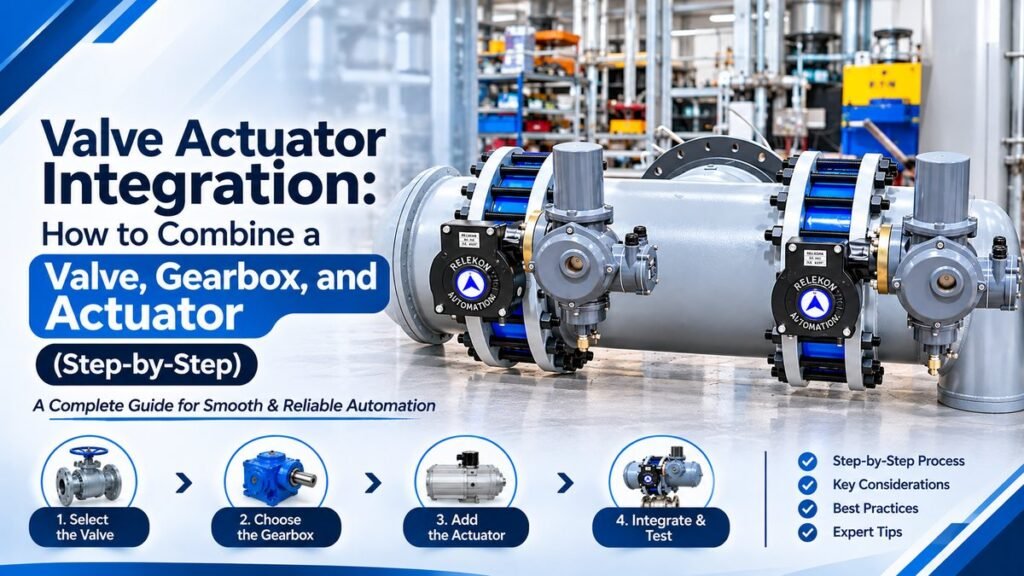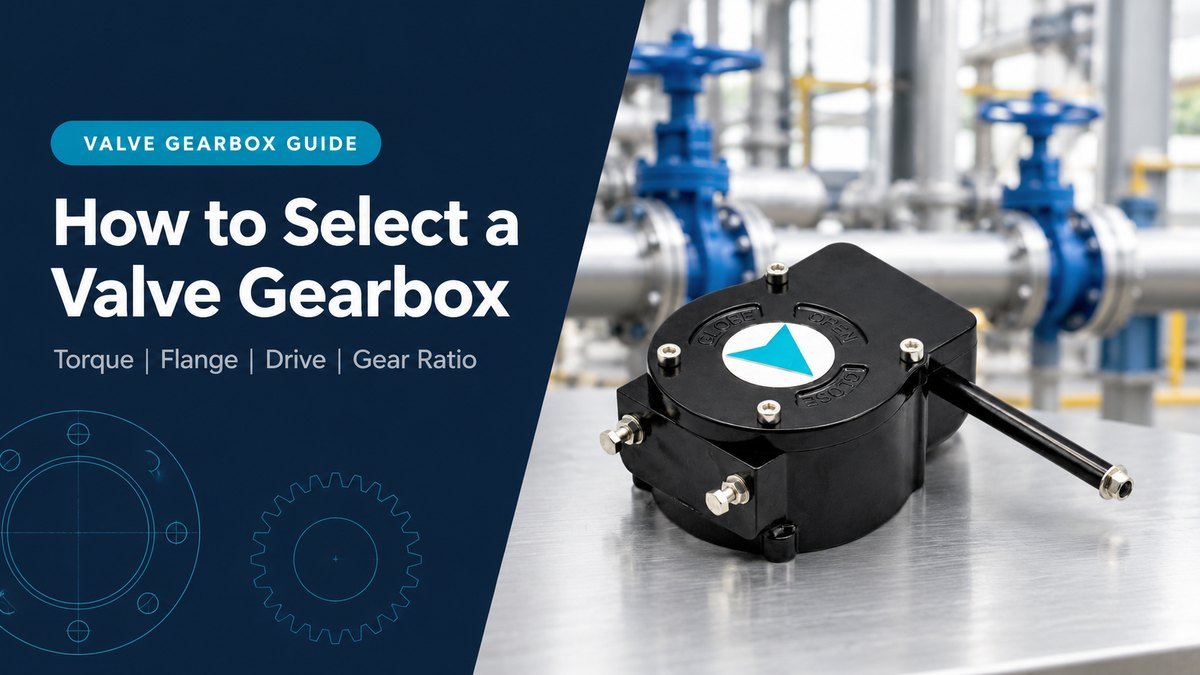
Quick answer: To select a valve gearbox, start with the valve type (quarter turn or multi turn). Take the valve’s maximum operating torque and add a safety margin. Then match the ISO 5211 flange and the drive (square, keyway or double D), pick a gear ratio that keeps hand wheel effort comfortable, choose manual or actuator operation, and specify the coating and accessories for the site.
A wrong selection shows up fast. The hand wheel is too heavy for one person to turn. The gearbox does not fit because the flange or drive is one size off. Or it works on day one and starts giving trouble after the first monsoon because nobody specified the coating.
At Relekon Automation, we see these mistakes in enquiries every month, and most of them come from one missing detail in the RFQ. As a valve gearbox manufacturer, these are the seven checks we run before we quote any gearbox:
- Identify the valve type
- Calculate the required torque
- Match the ISO 5211 flange
- Check the mounting drive: square, keyway or double D
- Choose the gear ratio and hand wheel
- Choose the operation type
- Specify the environment and options
At the end, you will find a checklist you can copy into your enquiry to get an accurate quote.
Step 1: Identify the valve type (quarter turn or multi turn)
The valve type decides the gearbox family before anything else.
| Valve | Movement | Gearbox family |
|---|---|---|
| Butterfly, ball, plug valve, damper | 90° (quarter turn) | Quarter turn worm gearbox |
| Large butterfly or ball valve with very high torque | 90° | High torque valve gearbox (worm + spur) |
| Gate, globe, sluice valve | Many turns | Multi turn bevel gearbox |
A quarter turn gearbox turns only 90° and has end stops. If you fit one on a gate valve, it cannot open the valve fully. A multi turn bevel gearbox has no end stops, so on a butterfly valve it can turn the disc past its seat.
For multi turn valves, also check the stem type. A rising stem moves up as the valve opens, so the gearbox needs a hollow output shaft with space for the stem. Tell your supplier whether the stem is rising or non-rising, and share the stem diameter.
Step 2: Calculate the required torque
Torque is the number that sizes the gearbox. Not the valve size.
Two 200 mm butterfly valves can need very different torque. A soft-seated valve on clean water at 6 bar might need a few hundred Nm. A metal-seated valve on slurry at 16 bar can need two or three times that. So when a buyer writes “gearbox for 8-inch valve” and nothing else, we always ask for the torque before we quote.
Where to get the torque value
Use the valve manufacturer’s datasheet. Look for the maximum torque, usually the breakaway (seating or unseating) torque at maximum differential pressure. That is the highest torque the valve sees in its whole stroke.
Add a safety margin
Valves get stiffer with age, deposits and long periods without operation. A margin of 25-30% on top of the datasheet torque is a common starting point for clean service. For dirty media, low temperature or valves that sit untouched for months, go higher.
Formula: Required torque = Valve maximum torque × Safety factor
Worked example: a butterfly valve datasheet shows 700 Nm maximum torque. With a 1.3 safety factor:
700 × 1.3 = 910 Nm required
In our RA series hand wheel gearboxes, the next model up is the RA-W1000, rated at 1,000 Nm. The RA-W700 (700 Nm) would run at its limit on day one, so it is ruled out.
Don’t overshoot by a mile either. A gearbox two sizes too high costs more, weighs more, and often needs a larger flange than the valve top has.
Step 3: Match the ISO 5211 mounting flange
ISO 5211 is the international standard for the flange between a quarter turn valve and its gearbox or actuator. Each flange size has a maximum torque it is designed to carry. Your gearbox output flange must match the valve’s top flange, and the flange must be rated for your required torque.
| ISO 5211 flange | Max flange torque (Nm) |
|---|---|
| F05 | 125 |
| F07 | 250 |
| F10 | 500 |
| F12 | 1,000 |
| F14 | 2,000 |
| F16 | 4,000 |
| F25 | 8,000 |
| F30 | 16,000 |
In the worked example, 910 Nm needs at least an F12 flange. The RA-W1000 comes with F12 or F14, so it fits a valve with either top flange.
The flange is only half of the connection. The other half is the drive, covered in the next step.
Step 4: Check the mounting drive (square, keyway or double D)
The flange holds the gearbox on the valve. The drive is what actually turns the valve stem. The gearbox output bore must match the stem end exactly, so check which of these three drive types your valve has:
| Drive type | What it looks like | What to share in your enquiry |
|---|---|---|
| Square drive | Stem end machined to a square | Across-flats (AF) size |
| Keyway (keyed shaft) | Round stem with a key slot | Stem diameter, key width and key height |
| Double D | Round stem with two parallel flats | Stem diameter and across-flats size |
Also share the stem height: how far the stem sticks up above the flange face. It has to suit the depth of the gearbox output bore.
A wrong drive size is the most common reason a gearbox arrives and doesn’t fit. Send the valve’s top-works drawing with your enquiry, and this problem disappears.
If your valve has a non-standard stem, share the drawing and we will check whether a customized valve gearbox output can be made to suit it.
Step 5: Choose the gear ratio and hand wheel size
The gear ratio decides two things the operator feels: how hard the hand wheel is to turn, and how many turns it takes to close the valve. You can’t have both low effort and few turns. Pick which matters more on your site.
Two terms get mixed up here:
- Gear ratio is the number of input turns per output turn. 44:1 means 44 turns of the input shaft for one full turn of the output.
- Mechanical advantage (MA) is the real torque multiplication after friction losses. It is always lower than the gear ratio because a worm gear isn’t 100% efficient. Use MA for effort calculations, not the ratio.
Formula:
- Input torque (Nm) = Required torque ÷ Mechanical advantage
- Rim force (N) = Input torque ÷ Hand wheel radius (in metres)
Back to the example. The RA-W1000 has an MA of about 12, a 44:1 ratio, 12 turns to close and a Ø350 mm hand wheel (radius 0.175 m):
- Input torque = 910 ÷ 12 ≈ 76 Nm
- Rim force = 76 ÷ 0.175 ≈ 433 N
That is a firm pull for one operator. If your plant has a rim force limit, or the valve sits high on a pipe rack, you have two fixes: a bigger hand wheel, or a higher MA model. The RA-W1500 (MA 14, same Ø350 wheel) drops rim force to about 371 N, but you pay for it in weight and a few extra turns.
Here is how the trade-off looks across the full RA series quarter turn worm gearbox range:
| Model | Torque (Nm) | MA (±10%) | Gear ratio | Turns to close | ISO 5211 flange | Hand wheel (mm) |
|---|---|---|---|---|---|---|
| RA-W125 | 125 | 8 | 40:1 | 10 | F05 | Ø150 |
| RA-W250 | 250 | 8 | 33:1 | 8 | F05, F07 | Ø200 |
| RA-W500 | 500 | 10 | 40:1 | 10 | F07, F10 | Ø250 |
| RA-W700 | 700 | 10 | 40:1 | 10 | F10, F12 | Ø350 |
| RA-W1000 | 1,000 | 12 | 44:1 | 12 | F12, F14 | Ø350 |
| RA-W1500 | 1,500 | 14 | 48:1 | 12 | F14 | Ø350 |
| RA-W2200 | 2,200 | 16 | 55:1 | 15 | F14, F16 | Ø350 |
| RA-W3500 | 3,500 | 20 | 73:1 | 20 | F16 | Ø500 |
| RA-W5000 | 5,000 | 50 | 90:1 | 66 | F16 | Ø500 |
| RA-W5500 | 5,500 | 65 | 90:1 | 66 | F16, F25 | Ø500 |
| RA-W7000 | 7,000 | 70 | 150:1 | 73 | F16, F25 | Ø600 |
| RA-W10000 | 10,000 | 75 | 300:1 | 80 | F25, F30 | Ø600 |
Past about 3,500 Nm, a single worm stage needs so many turns that operators start skipping full strokes. That is where a high torque valve gearbox with a worm + spur stage earns its place: the extra reduction keeps effort low on valves up to 100,000 Nm.
Step 6: Choose manual, actuator or manual override operation
Ask one question: who or what turns this valve, and what happens when that fails?
| Situation | Gearbox to choose |
|---|---|
| Operator turns it by hand, a few times a day or less | Hand wheel quarter turn gearbox or multi turn bevel gearbox |
| Electric or pneumatic actuator, normal size valve | Actuator-operated gearbox for valves |
| Actuator on a very large valve | High torque actuator gearbox (worm + spur) |
| Actuated valve that must still work during a power cut | Manual override gearbox (MOR) |
Why put a gearbox under an actuator at all? Cost. An actuator big enough to turn a large valve directly is expensive and heavy. A gearbox between a smaller actuator and the valve multiplies its torque, and the gearbox usually costs less than the jump to the next actuator size.
For actuator duty, the gearbox input side must match the actuator’s output flange and drive. Send the actuator make and model, and check the actuator’s speed and the gearbox ratio together: a high ratio with a slow actuator can stretch a 90° stroke into minutes.
If the valve is on a fire line, a water supply main or a process shutdown, ask what happens during a power failure. If the answer is “someone has to close it anyway”, you need a manual override.
Step 7: Specify the environment, coating and accessories
Two gearboxes with identical torque can last two years or fifteen. The difference is almost always the site conditions, and they are the part of an RFQ most often left blank.
Temperature. Our standard gearboxes are rated for -20°C to +80°C ambient. Outside that range, the grease and seals need to change, so say so upfront.
Enclosure. For outdoor, wash-down or flood-prone locations, ask for IP65 or IP67.
Coating. Standard paint is fine indoors. For coastal sites, chemical plants or anything that sits in the sun and rain, specify epoxy primer surface coating with an epoxy or powder-coat finish. Retrofitting coating later means taking the gearbox off the line.
Accessories worth deciding now:
- Side locking arrangement: lets the hand wheel be padlocked open or closed, for safety lockout and to stop unauthorised operation
- Limit switch provision: a mounting pad for a limit switch box so open/closed status reaches your PLC (see our valve automation solutions)
- Position indicator: shows valve position at a glance from the ground
- Chain wheel: for valves mounted too high to reach
- Extended stem: for buried or pit-mounted valves
Each of these is cheap to add at the factory and awkward to add on site.
Valve gearbox selection checklist (send this with your RFQ)
Copy this table into your enquiry. With every row filled in, a manufacturer can quote the right model the same day instead of going back and forth for a week.
| Item | Your value | Example |
|---|---|---|
| Valve type | Butterfly, wafer | |
| Valve size and pressure class | DN 300, PN 16 | |
| Media and temperature | Raw water, 35°C | |
| Maximum valve torque (Nm) | 700 | |
| Safety factor | 1.3 | |
| ISO 5211 flange | F12 | |
| Drive type and size | Square, 27 mm | |
| Stem height above flange face | As per valve drawing | |
| Operation | Hand wheel / actuator (make + model) / MOR | |
| Hand wheel size or rim force limit | Ø350 mm | |
| Mounting position | Horizontal pipe, wheel at side | |
| Site conditions | Outdoor, coastal | |
| Coating | Epoxy primer + epoxy finish | |
| Accessories | Side locking, limit switch pad | |
| Quantity and delivery location | 40 nos, Jamnagar |
The mistakes we see most often
- Sizing by valve diameter instead of torque
- Using the running torque instead of the breakaway torque
- Matching the flange but not the drive size
- Forgetting the actuator’s speed when picking the gear ratio
- Leaving coating and accessories for later
If you replace gearboxes on existing valves, keep a few valve gearbox spare parts in stock too: seals and bearings are the usual first failures.
Need help selecting the right gearbox?
Send us the valve datasheet, or just the filled-in checklist above. Our engineers in Ahmedabad will recommend the model, flange and ratio, and tell you upfront if a customized valve gearbox makes more sense than a standard one.
Get a free gearbox selection and quote
Call +91 97275 11990 or email relekonautomation@gmail.com.
Frequently asked questions
What safety factor should I use when selecting a valve gearbox?
A margin of 25-30% over the valve’s maximum (breakaway) torque is a common starting point for clean service. Use a higher margin for slurry, low temperatures or valves that stay unused for long periods, because breakaway torque rises over time.
Can I select a valve gearbox by valve size alone?
No. Valves of the same size can need very different torque depending on seat type, pressure and media. Always size the gearbox from the valve manufacturer’s maximum torque figure, then check the flange and drive.
Which drive types can a valve gearbox output have?
The common drive types are square, keyway (keyed shaft) and double D. Share the drive type, its size and the stem height with your enquiry so the gearbox output bore matches the valve stem.
What is the difference between gear ratio and mechanical advantage?
Gear ratio is the number of input turns per output turn. Mechanical advantage is the actual torque multiplication after friction losses, so it is always lower than the ratio. Use mechanical advantage to calculate hand wheel effort.
How do I calculate hand wheel rim force?
Divide the required output torque by the gearbox’s mechanical advantage to get input torque. Then divide input torque by the hand wheel radius in metres. For 910 Nm, MA 12 and a Ø350 mm wheel, rim force is about 433 N.
What happens if a valve gearbox is undersized?
The operator struggles to unseat the valve, the gearbox runs at or above its rating, and gear teeth and bearings wear early. In the worst case the valve can’t be fully closed when it matters.
When should I choose a worm + spur gearbox instead of a worm gearbox?
Choose a worm + spur gearbox when the required torque is high enough that a single worm stage needs too many turns or too much effort, typically on large butterfly and ball valves above a few thousand Nm.